TL;DR: OSHA silica Table 1 is the list of construction tasks in 29 CFR 1926.1153(c) where an employer can skip exposure monitoring if it fully and properly implements the listed controls and respirators. Off Table 1, the employer must assess exposure and stay at or below the 50 µg/m³ 8-hour PEL. Either way, you still need a written plan, a competent person, housekeeping limits and medical exams for 30+ respirator days a year.
On semiconductor and battery plant projects, concrete never stops: core drilling, saw cutting, grinding for anchors and coatings. That is why OSHA silica Table 1 comes up in almost every safety coordinator interview I set up. Hiring managers want to know whether you can find the right row and tell a foreman exactly what has to change before work starts.
How OSHA silica Table 1 works
Under 1926.1153(c)(1), for each employee doing a Table 1 task, the employer must fully and properly implement the engineering controls, work practices and respiratory protection for that task. Do that, and the employer is not required to assess exposure for it.
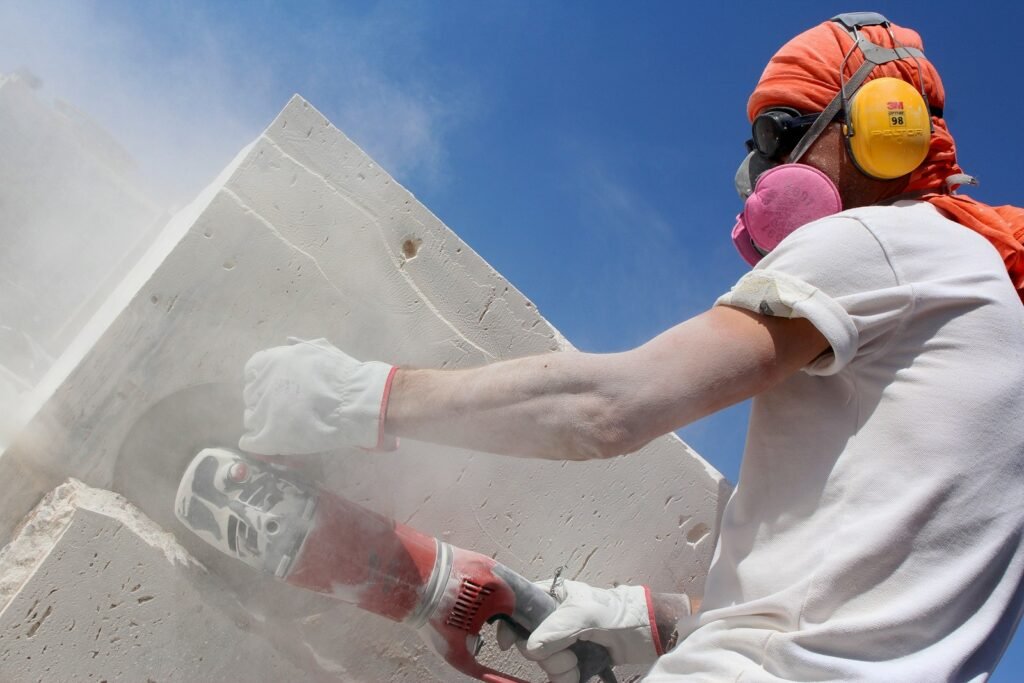
“Fully and properly” matters. If the saw’s water feed is clogged, the shroud is missing, or the vacuum is not the one the row specifies, you are off Table 1 and under 1926.1153(d).
The standard covers all construction exposure to respirable crystalline silica unless exposure stays below the 25 µg/m³ action level under any foreseeable conditions. The PEL is 50 µg/m³ as an 8-hour TWA. Indoors or in enclosed areas, Table 1 also requires exhaust as needed to minimize visible dust, and wet methods must use enough water to minimize visible dust.
Table 1 rows you will use most on plant projects
Common rows from 1926.1153(c), with the required respirator APF. “None” means the engineering control alone is enough when fully implemented.
| Equipment or task | Engineering and work practice control (summary) | Respirator, 4 hrs/shift or less | Respirator, more than 4 hrs/shift |
|---|---|---|---|
| Handheld power saws, outdoors | Integrated water delivery system | None | APF 10 |
| Handheld power saws, indoors or enclosed | Integrated water delivery system | APF 10 | APF 10 |
| Walk-behind saws, outdoors | Integrated water delivery system | None | None |
| Rig-mounted core saws or drills | Integrated water delivery system | None | None |
| Handheld and stand-mounted drills | Shroud with dust collection system | None | None |
| Jackhammers and chipping tools, outdoors | Water delivery, or shroud and dust collection | None | APF 10 |
| Jackhammers and chipping tools, indoors or enclosed | Water delivery, or shroud and dust collection | APF 10 | APF 10 |
| Handheld grinders, other uses, outdoors | Water delivery, or shroud and dust collection | None | None |
| Handheld grinders, other uses, indoors or enclosed | Water delivery, or shroud and dust collection | None | APF 10 |
| Walk-behind milling machines and floor grinders | Integrated water delivery, or dust collection | None | None |
Each row in the regulation has more detail, such as vacuum and filter requirements. Read the actual row before you approve a method.
We use water. Doesn’t that cover it?
Water feels like the safe answer. Candidates often tell me their crew wets the saw and assumes the silica rule is covered for the whole shift.
Table 1 under 29 CFR 1926.1153(c) lists controls task by task, with separate columns for 4 hours or less and more than 4 hours per shift, and if you do several Table 1 tasks in one shift the time adds up across all of them. So water on the saw doesn’t settle the grinder. Ask which Table 1 row covers each tool you actually run.
The 4-hour rule that catches people
Under 1926.1153(c)(3), if an employee does more than one Table 1 task in a shift and the total time is more than 4 hours, the “more than 4 hours” protection applies to every task. If the total is 4 hours or less, the “4 hours or less” column applies.
Example: an apprentice runs a handheld saw outdoors for 3 hours, then grinds outdoors for 2 hours. Total Table 1 time is 5 hours, so the saw row now requires APF 10, even though the saw ran only 3 hours. This is the most common Table 1 mistake I hear from candidates, and a good interview answer mentions it without being asked.
When Table 1 does not apply
If the task is not on Table 1, or the controls cannot be fully implemented, 1926.1153(d) applies. The employer must keep exposure at or below the PEL and assess it in one of two ways:
- Performance option: assess each employee’s 8-hour TWA using air monitoring data or objective data.
- Scheduled monitoring option: initial personal breathing zone monitoring, repeated within 3 months if above the PEL, or within 6 months if at or above the action level.
Employees must be notified of results in writing within 5 working days. Engineering and work practice controls come first; respirators supplement them.
The rest of the standard
- Written exposure control plan (g): tasks, controls, respirators, housekeeping and access limits, reviewed at least annually.
- Competent person (g): makes frequent and regular inspections to implement the plan.
- Housekeeping (f): no dry sweeping or compressed air where it could contribute to exposure, unless safer methods are not feasible.
- Medical surveillance (h): for 30 or more respirator days per year, at no cost, including a chest X-ray, spirometry and a latent TB test.
Nobody ever told me what silicosis was
I hear this from workers more often than I’d like. The rule puts that explanation on the employer. Under 1926.1153(i)(2)(i), covered workers must be able to show they understand the health hazards, which tasks expose them, the controls, who the competent person is, and the purpose of medical surveillance. Under (h)(1), exams start within 30 days of assignment and repeat at least every three years.
Worth asking on any new job: Will I be in a respirator 30 or more days a year? Who is the silica competent person here? When is my first medical exam?
For your resume, be specific: “Served as silica competent person; audited Table 1 controls on core drilling, saw cutting and grinding.” I cover the training baseline in OSHA 10 vs OSHA 30 and the path up in the construction safety manager career guide.
FAQ
Do I need air monitoring if I follow Table 1?
No, not for that task, as long as every control in the row is fully and properly implemented. Otherwise the employer must assess exposure under 1926.1153(d).
What is the silica PEL in construction?
50 micrograms per cubic meter of air as an 8-hour time-weighted average, with an action level of 25 µg/m³.
Can I use compressed air to clean silica dust?
Only with a ventilation system that effectively captures the dust cloud, or when no alternative method is feasible, under 1926.1153(f)(2).
Official sources
- 29 CFR 1926.1153, Respirable crystalline silica (eCFR)
- OSHA’s Respirable Crystalline Silica Standard for Construction (OSHA 3681)
Study guides and code books on Amazon
Check the edition year before you buy, and compare against the current eCFR text, since regulations change after books are printed.
- OSHA 29 CFR 1926 construction regulations book
- NIOSH Pocket Guide to Chemical Hazards
- CHST exam study guides
- CSP exam study guides
As an Amazon Associate, GRYNDHAUS earns from qualifying purchases.