TL;DR: A structural engineer semiconductor fab role is about stiffness as much as strength: vibration-sensitive floors, waffle slabs, heavy tool and equipment loads, pipe racks, and seismic and wind design. Expect ASCE 7, the IBC, AISC 360 and ACI 318 every day, and a license path of FE, then PE, then SE in states that require it.
I recruit for roles like this on U.S. fab and plant projects. Most structural engineers I talk to come from commercial buildings, industrial plants or bridges. They ask the same thing: what is actually different about a fab? My short answer: in a normal building, the floor has to hold people up. In a fab, the floor also has to stay still enough that the tools on it can work. That changes how you design, check and coordinate almost everything.
This guide walks through the real work, the codes, the tools, how licensing differs by state, and the questions I’d ask before accepting an offer.
What a structural engineer on a semiconductor fab works on
Described generally, a fab is a stack of very different spaces: a cleanroom level where the tools sit, a subfab below full of utilities, mechanical spaces, support buildings and a lot of exterior structures. The structural scope usually includes:
- Vibration-sensitive floors. Lithography, metrology and other tools have strict vibration limits set by the tool makers and the owner. The structure has to meet those criteria, not just code minimums.
- Waffle slabs. A common fab floor system is a thick, stiff concrete slab with a grid of openings, so air can flow down through the cleanroom and utilities can pass through. You will design around those openings, the column grid and the loads on top.
- Heavy equipment loads. Process tools, chillers, scrubbers, tanks, transformers and moving loads during tool install all need checking, often with load paths that change as the layout changes.
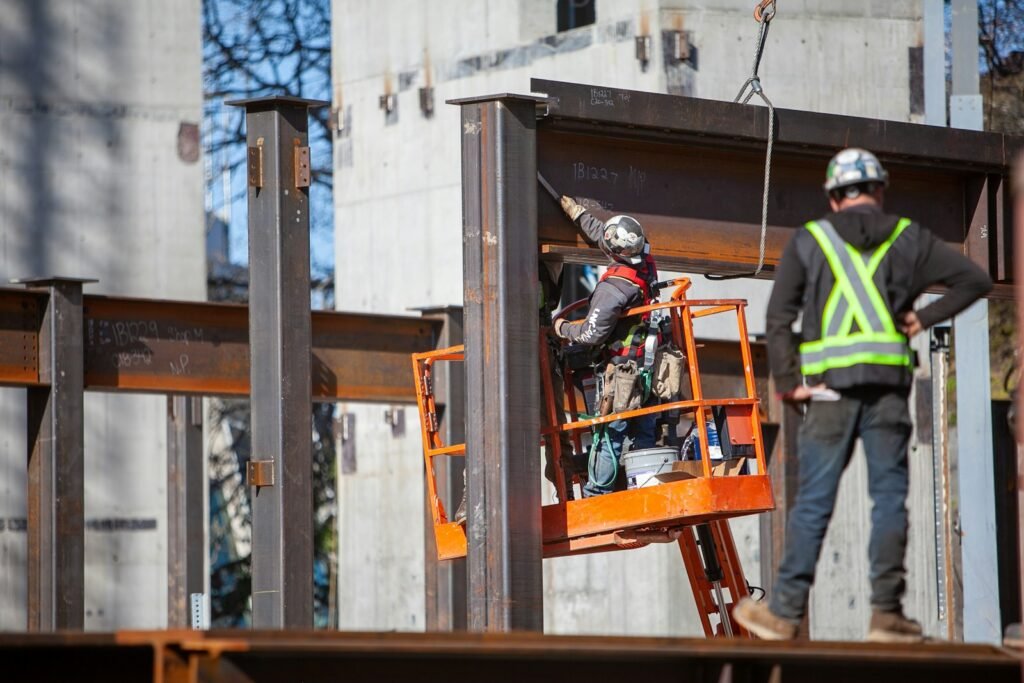
- Pipe racks and utility supports. Long steel racks carry piping, ducts and cable trays between buildings. They see gravity, thermal, wind and seismic loads and often grow as utilities are added.
- Roof and long-span framing. Large roofs carry mechanical equipment and exhaust stacks.
- Foundations and equipment pads. Isolated pads, mats and piles, working closely with the geotechnical engineer.
Vibration is usually the part that surprises people. For steel floors, AISC publishes Design Guide 11, Vibrations of Steel-Framed Structural Systems Due to Human Activity, which is a common starting point for floor vibration checks. On fab projects, the owner’s or a specialist consultant’s vibration criteria often govern, so ask what the project uses.
The codes: ASCE 7, IBC, AISC 360 and ACI 318
Your project’s code analysis decides which editions apply, because states and cities adopt codes on their own timelines. Here are the current editions named by the publishers, as of late October 2026:
| Code / standard | What it covers | Current edition (publisher) |
|---|---|---|
| ASCE/SEI 7 | Design loads: gravity, wind, seismic, snow, rain, flood, tornado and more | ASCE 7-22 |
| International Building Code (IBC) | Model building code; Chapter 16 covers structural design and references ASCE 7 | 2024 IBC (references ASCE 7-22) |
| AISC 360 | Specification for Structural Steel Buildings | ANSI/AISC 360-22 |
| ACI 318 | Building Code for Structural Concrete | ACI CODE-318-25 |
ASCE describes ASCE 7-22 as adding a tornado chapter, which matters for large industrial buildings in tornado-prone regions. The ICC material for the 2024 IBC states that it references ASCE 7-22 for loads. Note that a project permitted under an older adopted code may still use older editions. Always confirm with the engineer of record.
One exam tip: the NCEES structural exam specs list their own design standard editions, and they can lag behind the newest codes. For example, the 2026 SE Lateral Depth specification lists the 2018 IBC, ASCE 7-16 and ACI 318-14. Study the editions on your exam spec, not the ones on your project.
What the job really looks like day to day
Here is a typical design cycle on a fab building, step by step:
- Set the criteria. Confirm the code editions, risk category, site seismic and wind data, geotechnical recommendations, and the owner’s vibration criteria.
- Pick the system. Choose framing, floor systems, lateral system and foundations that meet strength, stiffness and schedule.
- Build the analysis model. Model the building, apply loads and combinations, and run gravity, lateral and vibration checks.
- Coordinate penetrations and loads. Work with mechanical, piping, electrical and process teams on slab openings, hangers, equipment weights and rack loads.
- Produce drawings and details. Plans, sections, connection and embed details, often in early packages while design keeps moving.
- Review shop drawings and submittals. Steel, rebar, embeds and precast or post-tensioned items.
- Support construction. Answer RFIs, evaluate field changes and new equipment loads, and visit the site.
On fast-track fabs, tool layouts change late. A big part of the job is re-checking areas when a heavier tool moves or a new utility rack is added. Engineers who track loads well and communicate changes fast stand out.
Tools commonly used
Firms pick their own software, so treat these as examples of commonly used tools:
- ETABS for building analysis and design.
- SAP2000 for general structures such as pipe racks, platforms and special frames.
- RAM programs for steel and concrete building design.
- Tekla for detailed steel and concrete modeling, often on the fabricator or detailer side.
- Revit and a model review tool for coordination, plus foundation and connection software.
If you used different programs, that’s fine. Explain the model, the decisions and how you checked the results.
Structural engineer semiconductor fab skills checklist
| Skill | Why it matters in a fab | How to show it |
|---|---|---|
| Vibration design | Tool performance depends on floor stiffness | Name the floor systems and criteria you designed to |
| Heavy industrial loads | Tools, tanks and racks drive design | List equipment types and load ranges you handled |
| Concrete design | Waffle slabs, mats and pads | Mention thick slabs, openings, mass pours |
| Steel design | Pipe racks, roofs, platforms | Mention rack design and connection work |
| Seismic and wind | Lateral design per ASCE 7 | State the code editions and systems used |
| Coordination | Constant changes from other trades | RFIs, model reviews, load tracking |
License path: FE, PE, then SE where required
The BLS Occupational Outlook Handbook says licensure isn’t required for entry-level civil engineers, and that state PE licensure generally needs an accredited degree, the FE exam, several years of experience and the PE exam. For structural work, some states go further.
- Pass the FE. The NCEES FE exam is computer-based, year-round, 110 questions in a 6-hour appointment, $225.
- Gain experience and pass a PE exam. Many structural engineers take the PE Civil (Structural) or go straight to the PE Structural, depending on the state.
- Take the PE Structural (SE) exam. NCEES says the PE Structural exam is computer-based, with separate vertical and lateral components, each with a breadth and a depth section. Breadth sections run year-round; depth sections are offered twice a year (next: October 27 and 28, 2026, then April 13 and 14, 2027). The fee is $350 per section, paid to NCEES.
- Apply for SE licensure if your state has one. Rules vary a lot by state.
Two examples of how different states are:
- Illinois: IDFPR’s PE vs SE guide says only an Illinois-licensed Structural Engineer can perform structural services there, and a PE cannot.
- California: BPELSG grants the Structural Engineer title to licensed Civil Engineers who pass the NCEES PE Structural exam and have three years of qualifying structural experience after Civil licensure.
If your degree is from outside the U.S., check your board’s education rules early. NCEES uses its own Credentials Evaluations for non-EAC/ABET degrees in an NCEES Record. For readers trained in Korea: a U.S. PE or SE is a state license, not the same system as the Korean 기술사 (for example 건축구조기술사), so don’t present them as equivalent on a resume.
Pay: what BLS says about civil engineers
BLS groups structural engineers under civil engineers. Per the BLS OOH, median pay for civil engineers was $100,840 per year in May 2025, and 51% of civil engineers worked in engineering services. Your offer will depend on location, license status (PE or SE), and seniority. Compare offers with my offer comparison calculator and see how to negotiate salary.
Do I have to switch firms to get a real raise?
Structural engineers ask me this with a mix of frustration and guilt, as if wanting more money were disloyal. I couldn’t find an official source that tracks how much engineers gain by changing jobs, so start from a neutral pay baseline.
For a neutral baseline, BLS has no separate category for structural engineers; they fall under civil engineers, whose median annual wage was $100,840 in May 2025, with $100,620 in engineering services. If the PE is part of your raise case, check where it counts: Each state sets its own rules, so the state board makes the final call. Before you jump, ask your current manager one direct question: what would my pay be once I’m licensed?
What’s different on Korean-affiliated projects
- U.S. codes, overseas reviewers. HQ engineering teams may review your design and compare it to fabs they built elsewhere. Be ready to explain where U.S. codes and local adoption drive the answer.
- Units and drawings. Reference drawings may come in metric; U.S. deliverables are often in imperial. Checking conversions is part of the job.
- Bilingual value. Korean and English together helps in coordination meetings, but most roles don’t require it. See bilingual Korean-English jobs.
- Location. Fab and plant projects are spread across several states, including Texas. Read Korean companies hiring in Texas.
Questions to ask in the interview
- Which buildings and structures would I own: fab, subfab, support buildings, racks?
- What vibration criteria does the project use, and who sets them?
- Which code editions is the project designed to?
- Who is the engineer of record, and will I work under a PE or SE?
- How much site time is expected?
- Does the firm support PE and SE exams with time or fees?
FAQ
Do I need fab experience?
Not always. Heavy industrial, data center, hospital or lab experience with vibration or heavy equipment transfers well.
Is an SE license required everywhere?
No. It depends on the state. Illinois requires an SE for structural services; other states treat it differently. Check your board.
Which ASCE 7 edition should I use?
The one your jurisdiction’s adopted building code references. ASCE 7-22 is the current edition, and the 2024 IBC references it.
How is the SE exam structured?
Vertical and lateral components, each with a breadth and a depth section, all computer-based. You must pass both components.
Will I need to go to the site?
Usually some. If you do, get OSHA training first; see OSHA 10 vs OSHA 30.
Not legal advice; your state board’s rules decide. Exam and pay details are as of October 2026. Sources: ASCE 7, ICC 2024 IBC / ASCE 7-22, AISC 360, ACI 318, AISC Design Guide 11, NCEES PE Structural, NCEES FE, IDFPR, California BPELSG, BLS OOH Civil Engineers. Software names are examples of commonly used tools, not endorsements.
Engineering exam prep and references on Amazon
For the SE exam, buy the code editions listed in the NCEES exam spec, not just the newest ones.
- ASCE 7-22 Minimum Design Loads
- AISC Steel Construction Manual
- ACI 318 structural concrete code
- Seismic and Wind Forces Structural Design Examples
- PE Structural (SE) practice problems
- TI-36X Pro calculator (NCEES-approved model family)
As an Amazon Associate, GRYNDHAUS earns from qualifying purchases.